Case Study 3: Sales Training
It’s not about training. It’s about changing how experts think.
Business Need / Problem
Research Now (now Dynata), a market research company with the one of the largest research panels in the world, acquired a location-based (geo-fencing) mobile survey technology. The acquisition opened an entire new market opportunity by allowing researchers to survey consumers while they were physically present at locations such as retail stores, sporting events, healthcare facilities.
Although the technology represented a significant competitive advantage, adoption was slow.
The Challenge
The company’s sales force had built its reputation on selling highly validated, pre-recruited research panels. Fro years they had differentiated themselves from “river sampling” methods that recruited unknown participants through social media, advertising, etc. Selling geo-fencing required a fundamental shift in how they view respondent quality and research design.
Customers shared many of the same concerns. They viewed mobile recruiting as less credible, relied on traditional survey approaches, and often treated sales representatives as order takers rather than strategic partners.
The challenge was not simply teaching a new product—it was changing deeply held beliefs and equipping sales representatives to help clients rethink how research could be conducted.
My Role
The Vice President of Sales engaged me to determine why adoption was lagging and design a learning strategy that would increase sales of the new offering.
Rather than immediately building training, I conducted an assessment by interviewing product experts, sales leaders, and sales representatives to identify the underlying barriers to adoption.
The assessment revealed two primary issues:
- Lack of belief in the product
- Weak discovery and consultative selling skills
Those findings became the foundation for the solution.
Solution
Build belief before building skill.
Instead of beginning with product features, I opened the program with our Vice President of Sales Operations—a respected sales veteran who had personally sold the solution. His role was to openly address concerns, explain the strategic value of geo-fencing research, and answer difficult questions from the sales team.
Starting with a trusted peer immediately increased credibility and reduced resistance.
Shift from product selling to consultative discovery.
I designed a three-day workshop around the DNAS sales methodology:
- Discovery
- Needs
- Ascertain Pain
- Solutions
Rather than teaching product knowledge alone, the program focused on asking better questions, uncovering business challenges, and helping customers recognize when geo-fencing created better research outcomes.
Participants practiced moving away from “show up and throw up” product presentations toward collaborative problem solving.
For example, one representative assumed a client requesting panel-only respondents at a ski resort should simply receive mobile surveys sent to nearby panel members.
Instead of accepting that approach, I challenged the class with questions such as:
“What is the likelihood enough panel members are actually on the mountain?”
“What could your client learn by surveying people who are actually experiencing the resort today?”
Rather than providing answers, I facilitated conversations that allowed participants to discover the advantages themselves.
Create realistic customer simulations.
Instead of traditional role-playing exercises, I recruited employees from across the organization to serve as customers.
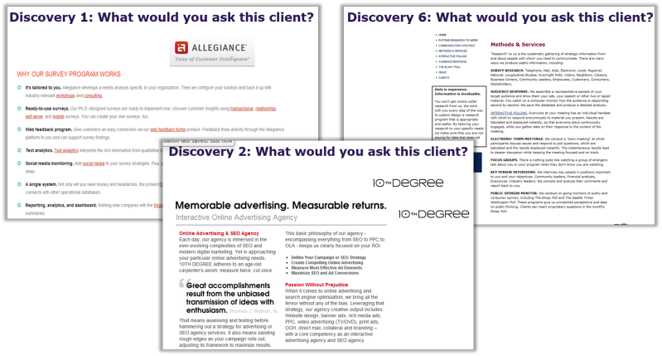
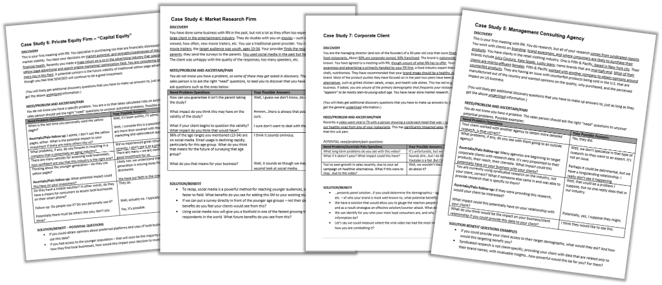
Each “customer” received background information, business objectives, and hidden requirements that sales representatives could uncover only through effective questioning.
On the final day, participants presented customized solutions based on their discoveries while peers evaluated what had been learned—and what opportunities had been missed.
The result was an experience that closely mirrored actual client conversations.
I later adapted the same learning approach for the Australian sales organization, developing industry-specific customer profiles that helped representatives expand beyond traditional market research clients into entirely new customer segments.
Key Design Elements
- Performance consulting before training. Conducted discovery to identify barriers rather than assuming additional product training would solve the problem. I studied how the technology was applied, and spoke with many sales reps. One note: I found the longest tenure reps with the biggest clients were the most resistant.
- Behavior Change before knowledge transfer. Addressed beliefs and mindset before introducing new sales techniques.
- Custom Case Studies, authentic practice. Designed realistic customer scenarios that required participants to think strategically instead of memorizing responses.
- Facilitation Over Instruction. This type of training requires excellent facilitation skills. This is a group selling multi-million dollar projects. A good facilitator leads them to their own answer, challenges them. To have the class give feedback to one another must be handled with tact and skill so it doesn’t feel like a witchhunt. You have to set the tone where it’s okay to fail.
Results
- Increased sales of the new geo-fencing product by 15%.
- The customized case study approach became highly requested for future sales training initiatives.
- Improved confidence in selling an innovative product that required customers to rethink traditional market research practices.
Artifacts